“Comparisons are odious.”
Oscar Wilde
“Anyone who tells you size doesn’t matter in investing is probably trying to sell you something.”
Warren Buffet
Whilst there is truth in Oscar Wilde’s observation that comparisons are odious, the work-a-day job of a global fund manager is to make judgments on the relative merits of competing investment ideas. One of the great benefits of Hosking Partners global, ‘go anywhere’ approach is the ability to compare all investments in our 40,000+ stock universe – regardless of sector, size or geography. We adopt the Deng Xiaoping philosophy, caring not if the cat is black or white, but whether it catches mice!
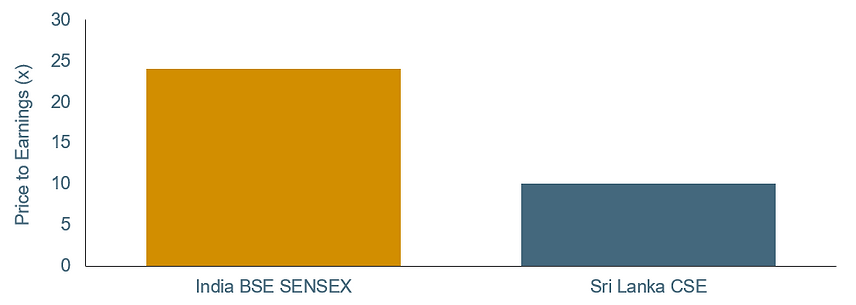
Moreover, it is a long-standing contention of your author that individuals make better decisions when the ‘choice architecture’ is stark. Beetroot-kale smoothie or whiskey-on-rocks for you sir? Searching out contrast takes advantage of the old market adage that one should only have strong views at ‘extremes’. In that regard, the capital cycle is our framework with which to avoid potential bubbles and seek out prospective ‘jewels’. We would submit that perhaps the most extreme contrast in emerging markets, perhaps even global, investing today is that between the India SENSEX exchange, trading at 24x P/E, and its neighbour the Sri Lankan CSE Index, trading at 10x.
India has undergone something of a stock market miracle in the past 15 years. The Nifty 500 delivering 383% (in local terms), for an annual return of 11%. The Modi reform agenda, financial liberalisation and hundreds of billions of dollars of foreign direct investments (FDI) and portfolio flows has turbocharged Indian economic growth. Indian valuations tower over all global markets to align with those of the ‘exceptional’ United States of America.
No doubt there remain compelling opportunities in India, particularly in small- and mid-cap shares for decades to come. For a thoughtful take on this opportunity set, I refer readers to Ben Watsa of Marval Capital, who gave a fantastic presentation at the Ben Graham Centre’s 5th European Value Investing Conference in Lisbon, where we both spoke in October 2025. This notwithstanding, the Indian stock market capitalisation-to-GDP ratio is now 144% – dangerously close to its own prior 2007 high, more than double that of China and well above the 100% fair value of the ‘Buffett indicator’. India has been the stand-out EM stock market ‘winner’ of the post Global Financial Crisis period.

Contrast this with Sri Lanka, an island nation some 15 miles off the southern tip of India. The tourist-dependent island was hit with a succession of economic calamities. In 2019 they experienced a terrorist attack, followed by Covid, which combined with a sovereign default in 2022 to precipitate a Great Depression-esque 70% USD stock market correction.
The Indian market weathered the Covid storm to reach all-time highs and is now some 2.5x more expensive than Sri Lanka on most conventional valuation metrics. Whilst India is of course bigger and the companies benefit from material scale advantage, it nonetheless has 3x the USD market cap per head of population than Sri Lanka. This despite Sri Lanka being the more developed economy, with GDP per head 60% higher at $4.5k versus $2.7k per head in India. The IMF-backed recovery has done little to stem foreign selling. 2025 marked the third consecutive year of net equity outflows, despite an unprecedented macroeconomic renewal: GDP growth above 5%, inflation at 1%, and three straight years of current account surpluses—the first since independence in 1948.
The investment opportunity for investors in capital-starved Sri Lanka is, therefore, threefold:
First, the cyclical economic recovery from the trauma of the 2022 default and subsequent bail-out reforms is likely to continue, to the benefit of major corporates. Many of the survivor businesses, for instance our investments in Dialog Axiata, John Keells, Aitken Spence and Lion Brewery, did not let the crisis go to waste. Mergers, capacity closures and foreign competitor exits have materially improved forward-looking returns for these new now dominant franchises.
Second, the economic pull-through of a growing $4+ trillion Indian economy continues to exert itself on Sri Lanka with its much smaller GDP of $100bn. Indian corporate ‘heavy hitters’ – i.e., Reliance, Adani and Bharti – are investing heavily in key infrastructure. Indian tourists numbered 500,000 in 2025 and now account for one in five visitors. But with an estimated 1.3bn Indians having never even been on an airplane (!) the runway (pun intended!) for Indian tourism growth is clear.
Third, the 2.5x valuation divergence will likely mean revert. In 2010 the Sri Lankan stock market traded at 20x P/E, above India at 17x. Sri Lanka was then a go-go EM growth market with a valuation to match. A great reminder that valuation extremes are transitory.
At the corporate level, the valuation divergence between the two countries illuminates the individual stock opportunity. The recently consolidated, three-player Sri Lankan mobile telecom market is valued at 15x P/E and 2.5x price to book. Set against a 40x P/E multiple and near 9x price-to-book multiple for Indian players. A lot has to go right at a 40x entry point! A simple telco market cap per head of population shows the huge growth assumptions built into India, which has $277 of market cap per head of population (population, not user! ). In Sri Lanka the same number is $68. And it must be re-iterated that Sri Lankans are 60% wealthier than their Indian “cousins”. This means the current $2.0-2.5 ARPU in Sri Lanka – some 25-50c below that of India – has an attractive horizon, especially given the roll out of 4G and near 20% CAGR in data usage seen in 2025.

Having seen the returns of our Sri Lankan investments annualise at 35% since 2023, we are naturally nervous of extrapolating performance.

That said, underlying earnings growth has driven much of the shareholder return. The relative merits of Sri Lanka – in a world of expensive equity valuations – remains compelling. How long is the runway for improved returns on capital? We wrote the following in a Hosking Post in June 2025:
“From a capital cycle perspective, economic distress, mixed with currency crises and investor pessimism, work to create what might be termed ‘country-level-capital-cycles’ …. During such periods the valuations of long-established ‘country champion’ type businesses can fall well below replacement cost. The snapback from deep discounts to more appropriate valuations can be rapid. Longer term these ‘survivor’ businesses often see a period of high returns on capital as competition erodes during and immediately post crisis. In a dysfunctional economy if you survive a crisis with your capital intact, pricing power improves dramatically!”
From where we sit now, the movie is playing out as we had hoped. Large, well-capitalised businesses are exhibiting high returns and, for now, minimal competition. On the basis that emerging markets follow a ‘seven years of feast, seven years of famine’, we would appear to be halfway through the traditional EM cycle. With the ‘option’ that, as India continues to develop, the earnings and valuation runway for our business extends the traditional EM cycle. One statistic that your author has spent a long-time pondering: mortgage debt-to-GDP in Sri Lanka is a paltry 2.7%. Set against 13% in India, 18% in Cambodia and 25%+ for middle income countries. There is a huge opportunity for household formation, construction and middle-class consumption. It is said that owning a home makes you accountable for the future. And if a rise in home ownership spills over into a more discipled and grown-up political system in Sri Lanka, the benefits for investors, and indeed the country, would be momentous. Would the Sri Lankan Mr. Modi please stand up?

1: Chart 1: Price to Earnings – India SENSEX and Sri Lanka CSE – World Bank, CBSL, CSE, Bloomberg, CT Securities, Dec 2025
2: Charts 2 & 3: SENSEX price chart & The Buffett Indicator – Bloomberg, FactSet. SENSEX for period 31 Dec 2006 to 20 Jan 2026. Buffett indicator – annual periods from 31 Dec 2006 to 31 Dec 2005. Buffett indicator is market cap divided by GDP.
3: Table: Telecommunications Market – CT Smith, Dialog Axiata, World Bank, Dec 2025
4: Chart 4: Total Return chart – Hosking Partners. FactSet. Hosking Partners Sri Lankan stocks consists of Ceylon Guardian Investment Trust PLC, C T Holdings PLC, Dialog Axiata PLC, Tokyo Cement Company (Lanka) PLC, Bukit Darah PLC, Richard Pieris & Co PLC, John Keells Holdings PLC, Aitken Spence PLC, Teejay Lanka Plc, Aitken Spence Hotel Holdings PLC, Lion Brewery (Ceylon) Plc for period 31 Dec 2022 to 31 Dec 2025. Price in USD. The portfolio holds all of these securities. This does not represent all the securities purchased or sold. Further details of the calculation methodology and a list showing every holding’s contribution to overall performance during the period is available upon request. Past Performance is not a reliable guide to future performance.
5:Table: India vs Sri Lanka comparison – World Bank, CBSL, CSE, Bloomberg, CT Securities, Dec 2025